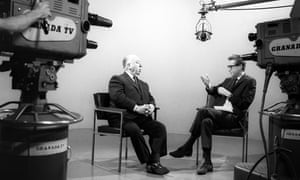
In 1959 – “the effective national coverage year” – Independent Television will already be available to “somewhere between 90 and 92 per cent of the population of Britain. This estimate was given yesterday by Sir Robert Fraser, director-general of the Independent Television Authority. He told the conference of the Incorporated Society of British Advertisers at Hastings that in 1960 they would try to close the gap between 92 per cent and 98 per cent, “which is probably as high as you can get,” and added that this would require the building of ten to fifteen small stations, “to fill in those gaps which are inevitably left by orderly television transmitting development.”
Sir Robert said that “opinion advertising” was not allowed by the Television Act. Political advertisements, for instance, would have to be rejected. And it went further than politics: opinion advertising on any important matter on which there might be two opinions was not allowed. “I have a feeling that, as television advertising gets __more and __more powerful, and more useful to prestige advertisers, there may be more moves in the direction of television for opinion advertisements,” he said.
Meeting the challenge
Earlier, Mr C. T. Barton, president of the Newspaper Society, said that the local press was full of optimism for the future. They were ready to meet the challenge – it was not a threat – of television. The Newspaper Society had started on the biggest programme of readership research ever undertaken in Britain. Region by region, it would cover “our great provincial and London suburban press.”
Mr Barton, who is chairman and managing director of the “Leicester Mercury,” said that while they accepted that television advertising could do much, “we know that local newspaper advertising can do much more. Nothing can adequately replace the printed word – the fullness and the permanence which are to be found in newspaper advertising.
Expressing confidence that, if the national economy continued to progress, Britain could follow the American pattern of increasing newspaper revenues, in spite of television, he went on: “Newspaper revenues there have increased all the time, and although they have not increased at the same rate since the emergence of television it is currently the television revenues which are reported to be experiencing a decline. The sensible thing for us of the provincial press to do is to recognise that Independent Television is here to stay. While it is a competitive medium it is at the same time a complementary medium, and that provides opportunities for each medium to support the other.”
American example
Mr H. W. Yoxall, president of the Periodical Proprietors’ Association and chairman of Conde Nast Publications Ltd., said the arrival of the “push-button age” did not mean the end of the press. After years of commercial television in America press circulations and book sales were bigger than ever. Publishers were faced with grave economic problems but he did not think television could escape the pressure of rising costs.
Lieutenant-Colonel M W. Batchelor, chairman and managing director of Batchelor’s Foods Ltd., thought that both the written word and television would suffer from intense competition, whereas by taking a common-sense view all should benefit. He suggested that the connection of many important press organisations with television companies was significant.
Mr John Coope, managing director of the News Chronicle and Star Ltd., said the so-called menace of television had been grossly exaggerated. Television, particularly commercial, had all the advantages of novelty; but the period of honeymoon would fairly soon be coming to an end – “and we shall see if the little woman is as good at cooking as she is at kissing.”