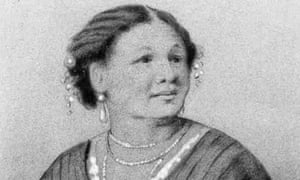
Mary Seacole, the Jamaican “vivandiere” who aided soldiers on the battlefront during the Crimean war and set up a “British Hotel” from which she sold food, drink and other supplies to the army, featured regularly in the pages of the Observer and the Manchester Guardian, both during the war and afterwards when she was living in London.
The reports, notices and classified ads in which she appears show how she was well-loved by servicemen and the wider public. So well-loved, in fact, that when she returned from the war in 1856 bankrupted by her activities, there were several attempts to raise money to support her. One of the most successful was her autobiography, The Wonderful Adventures of Mrs Seacole in Many Lands.
As soon as the book was published in July 1857, the Observer printed an extract and was full of praise for her and her autobiography, beginning: “Those who would wish to know what special claims of interest Mrs Seacole possesses on our sympathies cannot do better than refer to her ‘Memoirs’”.

The extract includes a moving description of how Seacole was affected by the deaths of soldiers who referred to her as “mother”: “I used to think it was like having a large family of children ill with fever, and dreading to hear which one had passed away in the night.”
The book was a huge hit, selling out its first run and being reprinted in 1858.
The troops’ enduring high regard for Seacole is shown in a short report in the Manchester Guardian of her visiting “military and naval heroes” in 1859, which describes how she was “received with the best feelings by officers and men [who] cheered her most enthusiastically.”

There had been previous attempts to raise money in aid of Seacole. As early as November 1856 a notice appeared in the Observer about a Reform Club member offering £20 to start a subscription on her behalf, and in 1857 a Seacole Fund was set up.

However, the fund was not successful until a decade later when it received the patronage of the Prince of Wales, the Duke of Edinburgh and the Duke of Cambridge, and Queen Victoria gave it her approval.

A classified advert for the fund appeared on the front page of the Observer in 1867 and was referred to within the paper with “much pleasure”.

After her death in 1881, Seacole’s fame declined and her memoirs were not reprinted again until 1984, when two researchers, doubtful of its existence, rediscovered it in the British Library catalogue. Subsequently, in 2004, she was voted greatest black Briton.
A statue of Seacole was unveiled outside St Thomas’ Hospital in London in June 2016.
Further reading
Mary Seacole’s memoirs reissued in 1984
Mary Seacole voted greatest black Briton
Sculptor defends his Mary Seacole statue
How to teach... Black History Month
Top tips for teaching Black History Month
Previous archive teaching resources
More teaching resources can be found on our resources for teachers page